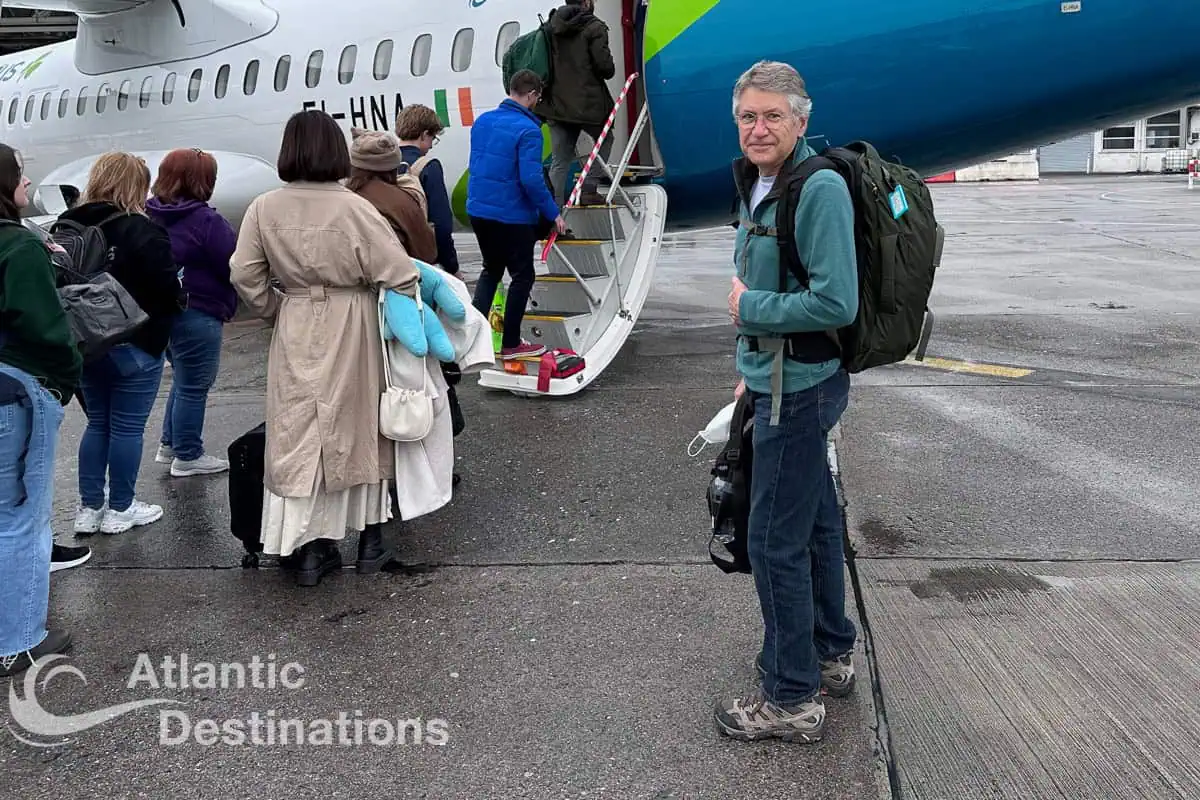
Choosing the best backpacks for air travel (if you’re over 40)
Share:

Several years ago, we visited our daughter and her family in Texas. We packed all our belongings in one big roller-bag and I hauled it around several airports, hoisting it on and off various belts and baggage carousels.
By the time I got home, my right elbow was killing me and it didn’t get better for a couple of months afterward. My elbow and I were determined to find a better way.
I considered smaller hers-and-his roller-bags to split up our gear. That would likely solve the sore elbow problem, but there are other issues that I find annoying with traditional luggage:
- Slow process at check-in.
- Airline bag fees.
- Fear of theft or lost luggage.
- Delays retrieving your luggage in customs when you have an international connection.
- Struggling to maneuver suitcases over cobblestones or through crowded streets.
But then I discovered travel backpacks — they seemed like the answer to all my luggage problems. But I needed to find the one that suited me best.
Here’s what I learned about choosing the best backpacks for air travel — one that would carry enough for a one-week holiday and be suitable for the over-40 crowd (like me!).
Using backpacks instead of traditional luggage has revolutionized our travel experience. Get the low-down on everything you need to know about traveling with backpacks:
The best backpacks for air travel combine carry-on compliance, comfort, and smart organization. A good one lets you skip baggage claim, breeze through security, and move easily between gates. Read on and I’ll share my experience with you about how to find the best backpack for your needs.
Why choose a backpack for air travel?
These days, travel moves fast. Short flights. Tight layovers. Stricter airline rules.
With overhead bins filling up before boarding is done, airline compliant backpacks give you more control. You can pack for a week, stay within carry-on limits, and still have your hands free for coffee or a boarding pass.
Comfort matters—especially when you’re crossing terminals that feel like small cities. Modern travel packs spread weight evenly across your shoulders and back. Padded straps, ventilated panels, and balanced frames take the strain out of long walks.
What I like most is how versatile a good backpack can be. It works just as well for business trips as it does for weekend escapes. With smart internal layouts, secure laptop sleeves, and lockable zippers, today’s designs keep everything organized and close at hand.
How to choose the right backpack for you
First, let me clarify that I’m way over 40 and if I can comfortably lug around an air travel backpack, those in their 40s, 50s, and 60s shouldn’t have much trouble.
I wanted a backpack that would be durable, fit in airline overhead compartments, could hold my clothes, laptop, and more, and be easy and comfortable to wear.
When we started looking for backpacks for air travel, we read reviews on the web, watched YouTube videos, and asked other travelers what they preferred (and why). Jackie even went and tried a few on at our local REI outdoor store.
Keep in mind that there’s no one right answer for everyone. You’ll choose the one that’s right for you. But there are six key factors that you should consider in making your choice.
- Airline compliance: Backpacks for air travel need to be small enough to comply with airline carry-on regulations and large enough to store everything you really need for your trip. The FAA says the maximum size carry-on bag for most airlines is 45 linear inches (the total of the height, width, and depth of the bag) and that anything larger should be checked. For most airlines, backpacks up to 42 liters are typically acceptable as carry-on luggage — mine is 40 liters and I’ve not had any issues.
- Organization, & storage: Smart compartments, front-loading access, and internal dividers for easy packing.
- I need help to pack and keep things organized inside the backpack. Packing cubes (either hard-shell boxes or resilient zip-up bags) are often available and fit inside the backpack to help you make the most of your space and keep things organized.
- I want to take enough with me to last for a full week of traveling (after than I’ll be using a laundromat). This includes electronics and cameras (all except the bigger DSLRs, which are in their own bags.
- Efficiency and access: How quickly can you reach what you need mid-flight or during security checks? I need quick and easy access to travel essentials such as my passport, charging cables, and reading glasses. Also, a side pocket for my computer is a must when I need to quickly unpack and repack it in the usually-crowded airport security line.
- Appearance and comfort: Adjustable straps, padded support, and ergonomic frames for strain-free wear. My backpack will be on my shoulders for a while, so it’s got to be as comfortable as possible. I learned that padded shoulder straps help, and that completely adjustable straps will secure it comfortably to your body. Waist straps and chest straps also help by taking some of the weight off your shoulders and spreading the load to your waist and hips. And, some packs have gender-specific back panels for men and women to increase comfort.
- Security and durability: Lockable zippers, strong stitching, and materials that stand up to years of use. I want this backpack to last for a while, so I’m looking for durable materials with reinforced stitching and quality zippers to withstand the rigors of travel. I want backpacks for air travel to have lockable zippers and hidden pockets to protect my belongings while I’m in the airport or in transit.
- Fabric and materials: Water-resistant fabrics that protect your gear from the elements. Let’s face it: there are countries we’ll travel to in which the default weather is rain (I’m looking at you Scotland!). I need a backpack made from water-resistant or waterproof materials that keep my belongings dry.
We also considered value for price, focusing on quality that lasts without overspending. Each pick balances practicality, comfort, and thoughtful designbecause the right backpack should make travel easier, not add to the stress.
New airline rules for carry-on baggage you need to know
Those of us who take small roller bags or backpacks into the secure waiting area know that, depending on the airline and the number of people flying on any given airplane, gate attendants may ask us to gate-check our bags.
They’ll tag your bag at the gate and return it to you in the jet-way when you leave the plane. It’s inconvenient, but it’s better than having to wait at the baggage carousel to pick it up, especially when you need it to go through customs.
But so far my fully-packed 40 litre Osprey has not been flagged and I’ve been able to stow it in the overhead bin and keep it with me — easier on the nerves than the alternatives!
This year, there are a few changes you need to know:
- Air Canada has a new fee for basic-economy carry-on bags on flights within the Americas, starting in January 2025.
- American Airlines has eliminated gate bag-sizers to speed up boarding, though they will still gate-check oversized bags.
Generally, backpack users should always check before flying as rules for size, weight, and fees can vary significantly.
- Carry on: allowable overhead bin size limits are often around 22 x 14 x 9 inches, but can be larger on some airlines, so always check. Checked bags have weight limits (often 23 or 32 kg), but carry-on weight limits are less common.
- Personal item: This is the smaller bag that fits under the seat. Max size is roughly 17 x 13 x 8 inches. Again, check your airline’s rules.
Which ones did we choose?
Jackie and I bought different brands, which is OK considering we are two different people!

I bought the Osprey Farpoint 40-litre Men’s Travel backpack. As well as meeting the above criteria, it also has different models for men and women, allowing for the different shapes of our backs instead of a one-size-fits-all gender design. So far, the male version has been very comfortable.
There’s lots of testimonials on the web about how rugged it is and after five international trips with it, I can add mine. So far and it looks as good as the day I bought it.
On the downside, it only has one exterior pocket (although I’ve been able to make that work for me) and the back pocket for water bottles is a bit difficult to use.

Jackie bought the 40-litre Thule Aion Travel Backpack. It has a huge amount of easily-accessible outside zipped pockets and compartments that hold passports, computer cords, and anything else she decides to pack. The open side pocket is easily accessible and perfect for water bottles.
It has separate compartments for her laptop and tablet (sometimes she travels tech-heavy!). It includes a bag for dirty laundry that snaps into the back.
The Thule’s waistband is sold separately, but also doubles as a separate fanny pack with its own raft of pockets and compartments. Jackie can use the fanny pack for daily necessities while we’re out touring and leave the heavier backpack at the AirBnB.
Oh… And, she liked the color…
On the downside, the bag is made of a canvas-like material that is more rigid than the Osprey’s, making it more difficult at times to squeeze it into a small overhead airplane bin (although we’ve always been able to “squish hard” and eventually get it in).
Our experience traveling with backpacks
Switching to backpacks for air travel was a game-changer for us.
Using our backpacks as our only piece of luggage increased our airport mobility and made getting to the gate much more convenient. I’m more peaceful about travel and airports as there’s little chance of losing my luggage or it being damaged or pilfered. It makes traveling easier and allowed us to pack more efficiently and stay organized on the go.
Getting ready to travel with a backpack:
One key to successful backpack traveling is learning to pack light (more on this below). I’ve found that you CAN pack enough clothes, toiletries, and technology for a full week’s trip as long as you’re not trying to bring the kitchen sink along with you.
Instead, think carefully about what you really need, what you might be able to acquire at your destination (instead of packing it), and how you go about packing things.

I use the Osprey’s top pocket for things I need to keep handy: my passport, charging cords for my phone, and glasses and ear buds for watching media on international flights.
When I first get on the plane, I can plop the backpack in the overhead, quickly pull those items out the pocket, and I’m all set with everything I need for the flight.
Both the Farpoint and the Thule have zipper that can be secured by locking the zips, preferably with a TSA-friendly lock. This allows the TSA folks can open the locks and inspect the luggage without damaging the locks or the backpacks.
My bag is ALWAYS with me so I haven’t used the locks yet. But in case I ever have to check it, I have the locks handy and would put them on.
At the airport:
The beauty of using backpacks for air travel is the freedom it offers. With all my belongings in the backpack, both my hands are free for tickets, passports, my smartphone (for air travel apps), and most importantly — snacks!
The backpacks meet carry-on size requirements (up to 42 liters allowed as a carry-on), so we don’t have to worry about checking them in at the counter or at the gate. If you’ve already got your boarding pass and have no bags to check, you can go directly to security, which saves a lot of time and hassle (and a few dollars in bag fees).
On several occasions, I’ve watched flight agents hand out red tags to passengers in the waiting area to check their bags at the end of the boarding ramp. These bags are put in the belly of the plane and returned on the boarding ramp at the destination.
But, each time the agents see I have a backpack and not a suitcase or roller bag, they’ve just passed me by… score!
The easy side-accessible, zip-up pockets for our laptops on both our bags makes it easy to unload at the security check-in. On one trip, I actually had two laptops in that pocket and it didn’t affect the comfort of the pack, even though it was a bit heavier as a result.
Social Interaction: One side benefit of using backpacks for air travel is that they often spark conversations with fellow travelers. It’s a great way to connect with others who might be using similar gear.
On the plane:
The Farpoint has one really useful feature: you can zip up an integral cover over all the shoulder and waist straps, which makes it much easier to slide into the overhead bin. Usually, I don’t zip that up till I’m past the gate and on the boarding bridge so there’s no question that it’s a backpack and not a checkable bag…
On larger planes, the backpack will fit in the overhead bin easily, easing it in bottom first with the top of the backpack (and the external access pocket) pointing towards you as you stand in the aisle.
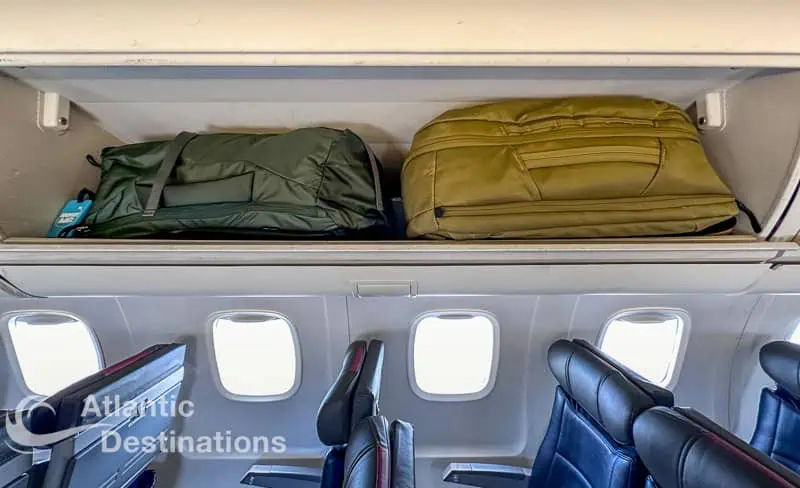
On smaller planes (see pic below), it still fits as long as you put it in sideways into the bin, with one proviso:
- As mentioned above, the Thule is made of a sturdier canvas-like material and it makes it more difficult to squeeze into a smaller overhead bin on a small plane (you can see the size difference in backpacks in the pic below).
- The Osprey is made of a nylon mesh type of material and gets no bigger than what you’ve packed into the back — no overhead bin squeezing issues here!
At the end of the ride:
When you’re disembarking or going through customs, there’s no wait for checked baggage. You can go immediately to the customs line or directly out of the airport.
Once when going through Dublin airport, the customs official directed me towards the baggage carousel. With a smile I said to him: “It’s all here on my back!”.
He returned my smile and responded: “That’s the way to do it!”
And, since your backpack for air travel is always with you, there’s no worries about lost luggage. I know a few friends that would rate that as the most important advantage…

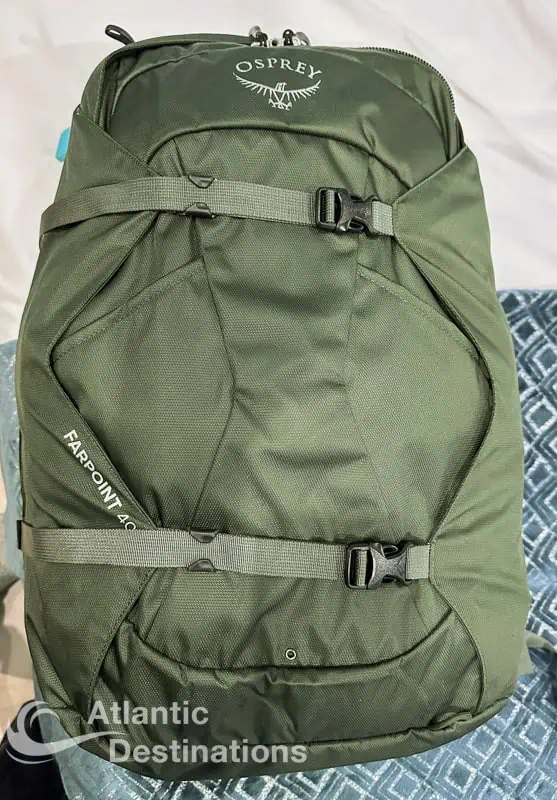

Osprey Farpoint: inside straps (left) keep your belongings together and compact, outside straps (middle) help keep the backpack compact and able to fit in tight places (like an airplane overhead, and although there’s no side pockets for water bottles, the pockets on the back can be used if you just loosen the outside strap a bit. Except for the drink bottle pocket, the Thule bag works the same way.
The downsides and how to mitigate them
Yep, there’s a downside. Jackie and I had slightly different experiences with our backpacks for air travel and these are the things to watch out for:
Weight on your back and your knees:
Backpacks are great if you’re young and strong. If you’re a bit older like me and have any back or knee issues, you may want to be careful. My knees are old enough to sporadically protest the 23 lbs/ 10.5 kilos I was carrying on my back.
How to mitigate this:
- Be sure your walking shoes are in good enough shape to support your feet and knees.
- Doing some back exercises before you leave helps build your back support, and keeps it limber and strong.
- Use the waist belt and chest strap if your backpack has them. It helps get the weight off your shoulders and distributes it with your waist and hips. This helps the overall balance of the weight and is not a huge factor in knee complaints, but every little bit helps!
- When you arrive and leave your destination and you’re wearing your full pack, keep walking distance to a minimum. Sometimes public transportation doesn’t drop you near our destination and the hike can be tiring. Plan to keep it short or, if it’s long, use an Uber or taxi to cover the final distance.
- If there’s time between your arrival and check-in, you can look (Google) for storage solutions (such as Stasher.com) at your destination to securely store your bag while you wait for check-in time to roll around. Stasher.com and other such services partner with hotels to offer secure luggage storage if you arrive early. This will keep the full pack off your back while you start to explore your destination.
- Once you’re at your accommodations, leave the backpack there. For daily touring necessities, bring a smaller bag that can lay flat in your backpack (or source one locally).
Limited packing capacity:
Backpacks for air travel usually have less space than traditional suitcases, which might be a drawback for longer trips or if you need to carry a lot of gear.
How to mitigate this:
Packing a backpack efficiently requires a bit of strategy. On multiple occasions, I’ve been able to carry enough for a week’s stay. Some people can do even better than that. Here’s some tips we’ve gathered from our experience:
- Pack like a pro: Pack only what you need. I brought one pair of jeans and one pair of comfortable shoes. I had enough shirts, socks, and underwear for a week, and I still managed to include my GoPro camera gear. Before we left, we checked out the options to wash clothes where we stayed.
- Rolling Clothes: This technique saves space and minimizes wrinkles. Roll your shirts, pants, and even underwear to fit more in your bag. Rolling clothes instead of folding them saves space and reduces wrinkles.
- Use Packing Cubes: I use the Osprey Ultralight Travel Starter Set, the light and durable zipped nylon packing bags for organizing my toiletries and technology. Jackie uses similar packing aids available for the Thule. I tend to put all my toiletries into one bag and my tech charging blocks and cords in another. Organizing them this way keeps them under control in your luggage and it’s easier to find things when you unpack them at your destination. There’s even a garment bag that helps you fold and store shirts while you travel to minimize wrinkles!
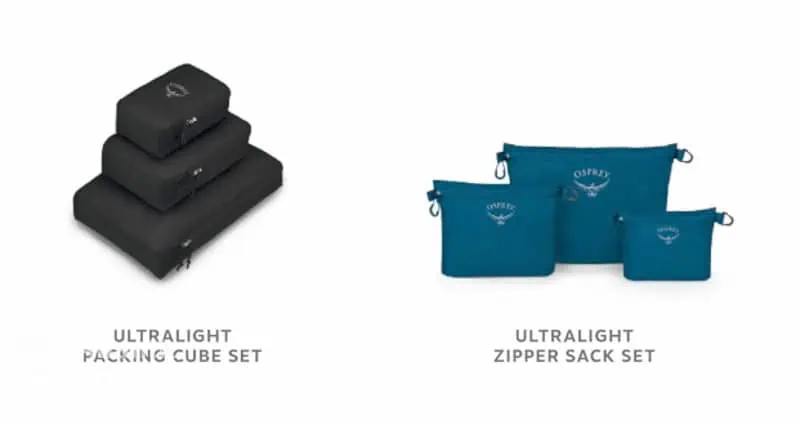
- Separate transparent bag for liquids: Transparent bags for liquids are available, and are especially useful for traveling in Europe where you’re obliged to remove liquids from your luggage for airport security inspection. If you don’t have many liquids, a Glad freezer bag will do. Don’t forget that some things like toothpaste are classified as liquids…
Accessibility
Getting items out of backpacks for air travel can be more challenging than with a suitcase, especially if it’s fully packed.
How to mitigate this:
- Keep travel essentials, such as those things you’ll need in the security line, at the gate, or on the plane, accessible via the external backpack pockets so you can get them quickly and don’t have to open up the backpack.
- For bigger things, such as the aforementioned transparent bag for your liquids, pack those at the top of the backpack so you can reach them easily when the time comes (or the security agent will do it for you!). Backpacks like the Thule have lots of exterior-accessible pockets which makes security checking a bit easier.
- Keep it secure: Use TSA-approved locks for added security, especially if there’s a chance you’ll have to check your bag at some point. If your backpack never leaves your side, you may be able to get away without them.
Wrinkled clothing:
Clothes may get more wrinkled in a backpack compared to a suitcase with flat packing surfaces.
How to mitigate this:
- When you reach your accommodations, hang the clothes up in the bathroom and run the hot shower and use the steam to de-wrinkle the clothing.
- Look for packing cube sets that include a garment bag that helps you fold and store shirts while you travel to minimize wrinkles.
Packing List Essentials
- Tech Gear: Computer, phone, chargers, power bank, and headphones.
- Documents: Passport, travel paperwork, and wallet.
- Clothing: Comfortable shoes, jacket, rain jacket, and versatile outfits.
- Toiletries: Basic hygiene items in a clear pouch.
- Accessories: Sunglasses, ear muffs, gloves, neck pillows, and umbrella.
FAQ
What size backpack can I carry on a plane?
Your carry-on backpack should be less than 50 liters (mine is 40), or about 22 x 14 x 9 inches. Sizes for international flights tend to be a bit smaller than American domestic sizes, which is why I have the 42 liter size. Your personal item (for under the seat in front of you) must measure no more than 18 x 14 x 8 inches.
Airline specs can vary, so check with the airline in advance of your flight. So far, I’ve not had any issues with the 42 liter size.
What size backpack is TSA approved?
Typically, the bag must be within the cabin baggage dimensions of around 22 x 14 x 9 inches (56 x 36 x 22 cm), commonly considered the standard size for carry-on.
What size backpack can fit under an airplane seat?
American Airlines advises customers to travel with personal items that are no larger than 18 x 14 x 8 inches. Delta Airlines specs are slightly different: 17 x 13 x 9 inches or smaller.
What’s the 3-1-1 rule?
Liquids, gels and aerosols packed in carry-on must follow the 3-1-1 liquids rule: each liquid container must be 3.4 ounces or less, they should be stored in 1-quart size, clear, plastic, zip top bag (all liquids must fit in the one bag), and each passenger is allowed 1 such bag.
Can I have a carry-on and a backpack?
Most airlines allow passengers to bring on both a carry-on and a personal item like a backpack, laptop bag, purse, briefcase, shopping bag, etc. The general rule of thumb is that your personal item is smaller in dimension than your carry-on bag and it must fit underneath the seat in front of you.
What size bag will fit in the overhead compartment?
Standard, domestic, carry-on luggage size is currently limited to around 22 inches tall, 9 inches deep, and 14 inches wide. A few airlines allow larger bags to be carried on. If flying internationally, plan to pack lighter or check your bag.
What size backpack for 2 weeks of travel?
When traveling across Europe with only a backpack for up to two weeks, it’s crucial to choose a backpack with the right features. Opt for a 40-45-liter backpack with padded shoulder straps, a waist belt for comfort, and multiple compartments for organization.
Can I put my backpack in the overhead bin?
Personal items “must fit under the seat in front of you,” while a carry-on bag must be able to fit in the overhead bin, according to their website. The airline lists “purses, backpacks and laptop bags” as examples of personal items.
Conclusion: less hassle, more freedom with backpacks
So, if you’re considering making the switch to backpacks for air travel, especially if you’re over 40 and looking for a more streamlined way to travel, we highly recommend it. It’s not just about carrying your stuff; it’s about enjoying the journey with less hassle and more freedom.
Plan your trip with our favorite resources
- #1 online accommodations booking platform. Booking.com
- Global guided tours with reviews: Viator
- Find, compare, and rent cars: DiscoverCars
- Buy travel insurance: SafetyWing
Got an opinion or an experience with backpacks you’d like to share? Go to the contact page and send a message using the form.